Jason Alexander was kind enough to retweet a link to that post, and I’ve gotten an amazing amount of feedback on it, from a number of very nice people. Many of those people think I’m crazy or full of shit, of course, but they were very nice about it. It’s humbling to have so many people have kind things to say about a little piece I knocked out in an hour or so before bed.
I had been keeping mostly silent on the issue of gun control, because it seemed like a dick move to be talking against gun control while people were still mourning their loved ones. Jason Alexander’s post made me realize that that wasn’t stopping the dicks. If reasonable people (and I do try) stay silent, that leaves the extremists to define the debate, and that doesn’t do anyone any good, so I decided to speak up. I’m glad I did.
A few more thoughts.
With the system we have now in the US, everyone has to pass a background check before buying a gun. The check is supposed to prevent convicted felons and people with a history of mental illness from buying guns. That’s a good thing. It can’t stop every nutcase–there are too many who don’t yet have any kind of record–but it’s a good start.
The problem with it is that too many of the relevant agencies don’t submit mental health data to that database. Fixing that seems to be a much simpler, less contentious, and more effective preventative than banning a single type of gun. Just get these agencies to follow the law and submit their data to the national background check database.
Combine that with the purchase flagging system I described last night and I think we could have something that’s pretty effective. (Implementation detail; when a person is flagged for questionable purchase patterns, it doesn’t just tap an investigator. It would also flag that person in the background check database, stopping any further purchases until they’ve been checked out.)
The purchase-flagging database and investigation idea isn’t perfect, of course. It wouldn’t catch everyone. There would have to be controls to keep it from being abused. But it would catch a lot of people. It probably would have caught James Holmes. He was crazy enough that just his voicemail message made a gun club think he was too unstable to be a member.
Whatever we do won’t be perfect. We can’t stop every bad person from doing bad things. But the ones we can stop, we should.
I believe very strongly that people have a right to own the means of self-defense. But I also believe that people have a right to not be shot by some nutcase while they’re just trying to watch a movie. Reconciling those positions is not easy, and anyone who claims it is is either lying or foolish. Or both.
We should also try to live up to the example of the Norwegians; a year after their own tragic massacre they haven’t changed their laws at all. They haven’t panicked.
“The Norwegian response to violence is more democracy, more openness and greater political participation.” –Prime Minister Jens Stoltenberg
These are tough issues that reasonable people can disagree on, but only by disagreeing reasonably do we have some chance of finding common ground, and a solution.
I expect this to be the last thing I have to say about gun control for, I hope, another five or ten years.
I’ve written, recently, to try and lay out a few facts about gun control and what we might do about it. The response to those pieces has been interesting. Most people don’t seem to care about why people like James Holmes go on their sprees. They don’t seem to want to really do anything serious to prevent future massacres. One side doesn’t want anything done at all, the other is only interested in banning AR-15s. (Very curious considering that James Holmes seems to have carried out most of his shooting spree with a shotgun. Why then is all the attention on the weapon that didn’t work?)
It was very baffling to me. These people are not, for the most part, stupid or malicious. Why, then, did they seem to care so much about the wrong things? Am I the one who’s wrong? (No way!)
My position is the same as it’s been for years regarding airport security; the tool isn’t nearly as important as a person’s willingness to use it to do harm. This seems so obvious to me that I’ve always been puzzled why other people don’t see it. But I think I’ve figured something out in the past few days.
This comic sums it up:
When we live in close proximity to thousands, tens of thousands, of complete strangers, we have to take it on faith that they won’t try to kill us. We, quite literally, aren’t built for this. Humans lived for millions of years in small bands of hunter-gatherers, in close-knit social groups where everyone knew everyone else. You might not like everyone else in the group, but if you had enemies you knew who to watch out for. These people could be trusted, those might try to harm you; no unknowns. (People from another band, of course, were enemies who would try to harm you. We haven’t gotten away from that bit of evolution either.)
Today, we live surrounded by people. We can’t know and trust more than a tiny fraction of them, but we can’t go through our lives constantly on guard against attack by every stranger we see. We have to take it on faith that other people have no interest in doing us harm. Our society can’t work any other way. When you get on a crowded elevator, you have to be comfortably certain that one of the other people isn’t going to stick a knife in your back. So certain that the thought never even enters your mind. Because if someone else on that elevator wanted to stick a knife in you, there’s nothing you could do about it. You’re standing there staring at the numbers over the door, waiting for your floor to light up, and there are five people behind you and if one of them decided to see what your insides look like, he can.
We trust our lives every day to people we don’t know, who we’ve never seen before and will never see again. Any other driver you see on the highway could crash into you at any moment. All that person in the next lane over has to do is yank the wheel and you’re dead. That nice person who compliments you on your beautiful baby might break your baby’s legs.
We have to believe that they’re not going to do that. We have to. Without a certain level of trust, of belief in the fundamental goodness of the people around us, we can’t function. Nearly everyone you see on any given day has the ability to harm or kill you; it’s only the fact that they don’t want to that keeps you alive.
We don’t think about this. We can’t; it would drive us crazy if we did. That’s why these mass killings shake us up so much more than a far greater number of traffic deaths. Traffic deaths are (mostly) accidents; we can take thirty of forty thousand of those a year in stride. We don’t even think about it.
A dozen people killed by a random stranger, though, strikes at that trust, that fragile assumption of good intentions, that holds our society together. It suddenly, at a very deep level, makes us fear that person behind us on the elevator. The delivery guy bringing a box into the office. We look at people differently.
We realize there is a chance that the stranger really is out to kill us. Not a huge chance, not likely, but it’s there. It can happen. We may not think about it consciously, but the fear is there.
Our civilization can’t work that way, though. We can’t live in cities together if we don’t trust the strangers who surround us. If our trust in strangers is shaken, but we can’t get away from them, what can we do? We’re stuck.
So our monkey brains patch around the problem, just as they’ve been doing for thousands of generations.
Some of us internalize the fear. Those people embrace the paranoia. They stroke their guns and think, “I would have been ready. I wouldn’t be a victim. No one will get me.” They arm themselves and so gain the strength to face the endless parade of potentially dangerous strangers.
Some compartmentalize it. It’s not strangers they have to worry about; it’s guns, or certain kinds of guns. They narrow the source of the danger, at least in their own minds, to a point where they can function without being afraid of everyone they see.
Some blame movies or comic books or video games. Get rid of those things and strangers won’t want to kill them.
That’s why some people cling more tightly to their guns in the aftermath these tragedies, while other people call for getting rid of those guns. It’s two different coping mechanisms for dealing with the same problem, the same fear. It’s unfortunate that the two methods are not just incompatible, but directly opposed.
There’s another thing we do: We forget. Within a few weeks, the memories fade and so does our fear and mistrust. We can again carry on our daily lives without fear, even though surrounded by strangers. It’s easy to mock how quickly we forget, but how could we carry on if we didn’t?
I still think that banning certain kinds of guns is the wrong solution, because there are so very manydifferent ways that strangers can hurt you that it’s futile to try stamping them out one at a time, but I better understand the impulse now. Those people, like the rest of us, are just trying to find a way to get through their day.
If we are ever going to stop tragedies like the recent one in Aurora, though, we have to look past the tools and at the people. It’s not something we’re comfortable looking at. It forces us to admit that some of those strangers are dangerous, do want to kill us, and that’s very disturbing. That’s why we ignore it. It’s not the people, it’s the guns/movie/video games. Make those things go away and all will be good!
But it’s not the things. It’s us. We have to gain some understanding into why some people want to commit these atrocities, maybe even find some way to identify them beforehand and stop them, help them.
Because if we don’t, the killing will go on. No black rifle is as dark as the evil that might lurk in the heart and mind of the stranger standing next to you.
Dan Rutter has a nice review of a bad war movie. From his perspective, safely thousands of miles away from the US Government, he makes some cutting points about how our propaganda machine is merging the War on Terror and the War on Drugs, two great tastes that taste great together (to someone, anyway).
As I’ve been saying for years, no number of foreign terrorists who ‘hate our freedom’ can do anything about it. Only we can, and our domestic ruling class who hate your freedom seems eager to do just that.
In New York, we’ve created a monument to our loss of the War on Terror, a celebration of fear and pointless, oppressive security. News stories everywhere urge us to ‘never forget.’
Here’s the best way to commemorate the 9/11 terror attacks: Forget. Move on, enjoy your lives. Live, without fear.
Since everyone is running around right now asking, “What to do!?” about mass murder incidents (but not really wanting an answer; it’s a rhetorical question, since they already have an answer and usually don’t want to listen to any alternatives) I thought I’ll pull together what I’ve written in various places on the subject.
So, you say you want to stop school massacres? Okay, here’s what you do.
First, secure the schools. I’m not necessarily talking about really expensive systems here; even just locking the fucking doors would be a start. (One in three school administrators admits to leaving doors propped open. ) Right now it’s harder to get into a computer data center than into most schools. What does that say about our priorities?
Second, make sure that the various mental health facilities and organizations update the NICS (National Instant Criminal Background Check) database, like they’re supposed to. I mean like really make sure they do it. As in, if some head-shrinker doesn’t file the required reports, and the person goes on to kill someone, the negligent head-shrinker, or administrator faces criminal charges as an accomplice. That’ll perk ’em up.
Third, spend some money and fix our broken mental health care system. These mass killings started after Reagan butchered the system back in the ’80s. It’s time to fix it. Colorado, is at least, making a decent start.
Fourth, stop making celebrities out of mass murderers. When someone runs onto a baseball field, they cut the camera feed from the field so as to not give that person any publicity, and encourage others. But if someone kills a bunch of people, they become the most famous person in the world, at least for a few weeks. Let’s stop doing that; do not mention the criminal’s name, do not show their picture. Instead of becoming celebrities they disappear, unworthy of mention.
Fifth, create a smart database of firearms-related purchases. This one requires a little explanation. The idea is that, as I’ve said in relation to other security problems, there are no dangerous weapons, only dangerous people. The most dangerous weapons you can imagine–an armor-piercing semi-automatic nuclear missile with a bayonet, hollow point, and a cyanide coating–isn’t going to do anyone any harm if the holder doesn’t want to do any harm. But practically anything is dangerous if someone does intend harm.
So, watch for people who intend to do harm.
So, put all those transactions into a database. Guns, ammunition, accessories, training classes, all of it. Let people buy what they want (within the limits of current laws, of course), but track it. Any unusual purchases–someone who’s never bought a gun before goes out and buys five in one week, for example–throws up a flag in the computer system and that person’s information gets routed to a special investigative division of Homeland Security, who would then check this person out. A flag would also be thrown in the NICS database, putting a freeze on any firearm purchases by that person. If their address comes up in the NICS system flagging another household member, they get flagged too.
Here’s the thing; this can’t be some ordinary beat cop, some TSA package-grabber, who does the investigating. The investigator has to be more psychologist than cop, because the idea isn’t to determine what the person has done, or what they’ve bought, or what they may be guilty of. We already know that what they bought, and they may not be guilty of anything, yet. The idea is to determine their mental state, to try and get an idea of what they might do.
In other words, if someone starts buying a bunch of guns out of the blue, send a smart person over to talk to them and try to find out if they’re a fucking nutcase who’s about to flip his shit and kill a bunch of people.
Why do this rather than simply ban dangerous guns? Because banning dangerous guns is not only hard, it’s ineffective. People right now are calling for a ban on ‘assault weapons’ to prevent another Newtown shooting, but Connecticut already has a ban on assault weapons. The shooting happened anyway. Gun control alone doesn’t work. Guns aren’t even the most dangerous thing an attacker can use, though you wouldn’t know that from the news coverage. We need to think harder, try harder, and come up with something more effective than one-note rote responses. We can do better.
These things aren’t perfect. Nothing we can implement is going to be perfect. People are inherently imperfect, and some bad people will always find a way to hurt other people. But this plan would, I think, work better than any other proposal I’ve heard. We can stop most of the bleeding, and I think we should.
This is an interesting poll. It would appear that, at least according to this Gallup survey, the common people think that increased school security, better mental health care, and changing the media’s depiction of violence would all be more effective than an ‘assault weapon’ ban. Even 33% of self-professed Democrats think that such a ban would not be very effective.
This is in sharp contrast to the political class, which is all about, and only about, gun laws. It will be interesting to see how this plays out as they get a better sense of how the voters are leaning.
Biden talked also about taking responsible action. “As the president said, if you’re [sic] actions result in only saving one life, they’re worth taking.
Really, Joe? Really? Saving one life is worth any price? Here are a few things off the top of my head that will not only save more than one life, but save many, many more lives than a silly ban on ‘assault weapons.’
Pull our troops out of the Middle East.
Ban swimming pools.
Implement some common sense car safety legislation (more on this later).
Order a serious study of the side effects of psychoactive drugs, and implement stricter controls on them.
Ban alcoholic beverages.
Ban hamburgers.
Free health care for all households with an income under $50,000/year. Subsidized low cost care for every household making under $75,000/year.
Some of these measures may sound pretty extreme to you (it’s silly to think that the government would risk angering the pharmaceutical industry), but it’s not me saying that they’re worthwhile; it’s the President and Vice President of the United States of America. Anything that might save even one life.
I wasn’t going to do this one, but the level of rhetoric about guns has become so strident, so hysterical, that I just had to do something to try and inject a little reality back into the dialogue. We have the White House right now saying that anything that saves even one life is worthwhile, which sounds nice but as a guideline for public policy in a nation of over 300 million people is madness. Then we have Robert Reich saying that the very nation is in jeopardy of “succumbing to mass violence.” The actual existence of the United States is at stake! We are all on the verge of utter destruction because of gun violence! Or perhaps the air is simply getting a little bit thin up here.
Among other things, I will look at the scale of gun violence, and I’m going to answer that perennial question, “Why do you need an assault rifle?” The answer isn’t what you think.
Before I get to it, let me say a few words about my background and point of view, so that the people who leap to incorrect conclusions about my motives, parentage, humanity, and political orientation can do so in full confidence that they are entirely divorced from the facts, just the way they like it.
First, you’re wrong about me. I’m a political independent from Massachusetts, have voted Democratic more often than Republican, believe in gay marriage and socialized health care. I’m also an atheist (or, if you prefer, a classical Epicurian.) I support all civil liberties, for everyone, which puts me at odds with both political parties. I’m a historian by training, which strongly colors my view of any public policy issue. To me, fifty years ago is the recent past, and fifty years from now is the near future. I take a longer view than pretty much any politician, or analyst for that matter, that you’re likely to see. I don’t believe in broad conspiracy theories, but I do believe that governments, like any other large organization, act in their own best interest and often for reasons other than what they say. That’s not paranoia or conspiracy theories; that’s looking at the record. Most of all, most importantly, I’m a dad. I do a lot of thinking about what kind of country my son is going to inherit, and how I’ll explain to him what we let happen to it.
Okay. Down to the serious business of offending everyone.
By The Numbers
We need to start by gaining an understanding of the scale of the problem that we face. The impression one gets from the news media is that guns are tearing a swath of destruction across our nation on an unprecedented scale, with every one of us (And our kids! Think of the children!) at immediate risk of being massacred. In fact, sources say that you’ve probably been shot and killed already.
This isn’t, in fact, true. Nor is this hysteria, as some would have it, a conspiracy on the part of the ‘left-wing liberal media.’ It’s simply the way our news industry works. They do their best to scare the shit out of us with practically every story that comes along. Gun violence has actually been on the decline since the mid–1990s, probably as part of a general decline in crime that may be environmentally related.
How bad is our level of gun violence in the United States? Well, it’s bad. I won’t try to deny that; this is a violent country. It’s worse than most of the civilized countries of the world. But, to look at it another way, if you subtract out the murders committed with guns, our homicide rate still exceeds that of many other countries. The problem is the violence, not the tool. Here are some numbers, to put things in perspective. Warning: This is grim. I’m going to concentrate on children, since that’s where most of the attention has been focused in the wake of the Newtown, CT killings, and to focus as closely as possible on innocent victims.
FBI’s Supplementary Homicide Reports
Table: Year of incident by Weapon used for United States
The numbers are depressing to look at, especially the terrible weight of thirty one years of child murders. Every one of those deaths is a tragedy, and I’m sure every family was devastated. We can easily see that guns have taken a terrible toll on our children over the last generation. Nearly 16% of all those homicides are known to have been committed with guns.
(Yes, the cause of death in 7,776 cases is unknown, and some of those were probably committed with firearms, but I think the distribution is proportional between the categories of weapon, with firearms probably making up a slightly smaller proportion, relatively, of those ‘unknown’ causes. Bullet holes are distinctive and usually easily identified.)
The most common weapon used to kill children is ‘personal.’ That is, hands and feet. Most murder victims under 12 years of age were strangled or beaten to death.
It gets worse.
That’s what the kids were killed with. Here’s who killed them.
FBI’s Supplementary Homicide Reports
Table: Year of incident by Relationship for United States
Again, we have a significant number of unknowns (which, in this case, means a depressing number of unsolved cases, which probably overlap with the ‘unknown’ weapon used above) which, again, can probably be assigned more or less proportionally between the other categories.
We can clearly see who the greatest danger to your child is.
You.
More than half of the murdered children were killed by family members, and another huge block by ‘acquaintances.’ Strangers only account for about 3.5% of the cases.
Combining these two sets of statistics we can see that, relative to the number of children murdered, very, very few are shot by strangers. Most are beaten to death or strangled by family members or other people known to them.
Okay, so strangers with guns may not be a prevalent danger to your children, but what about firearm accidents? Considering how many guns there are littering the countryside, there are doubtless terrible numbers of children getting their hands on them, with tragic results.
Accidental Deaths of Children 0–11 Years Old
Year
Mot. Vehicle
Drowning
Fire
Falls
Poison
Firearm
1999
1,961
812
566
103
66
39
2000
1,912
833
555
68
71
55
2001
1,783
769
480
98
74
40
2002
1,662
730
457
82
79
32
2003
1,691
684
423
92
98
28
2004
1,705
656
450
89
52
37
2005
1,614
719
417
69
60
47
2006
1,544
686
372
85
66
35
2007
1,385
673
409
80
74
47
2008
1,164
661
326
81
68
42
2009
1,175
637
308
84
78
34
2010
1,067
638
279
50
60
41
Total
18,663
8,498
5,042
981
846
477
The motor vehicle category includes pedestrians struck by motor vehicles.
About 40 children die every year in firearms accidents. I honestly expected the number to be higher than that, but I checked it three times and there it is. Half-again as many children under 12 die of accidental poisoning as firearm accidents. A child is 26 times as likely to be killed by a car, 15.5 times as likely to drown.
(We’re making progress, at least; the road, drowning, fire, and falling accidents have been coming down. Poison and firearms have stayed steadier, though smaller numbers are more subject to statistical variation, and harder to reduce. Also, the number of deaths has stayed pretty constant, even as the number of children and guns have increased, meaning that the rate of firearm accidents has gone down. Similar with poisons; the number of deaths has remained steady while the number of children has increased. Signs of hope.)
If 150 or so young children killed by firearms every year (accidents and homicides) is a tragedy–and don’t misunderstand me; it is–what should we make of the 1,100 or more killed on the roads every year, or the 640 who drown? Or the 350 beaten to death?
* * *
I haven’t dragged you through all these numbers simply to depress you (though frankly, it has depressed me, and I’m going to give my little boy an extra-big hug in the morning), or to try and make light of the children who’ve died. The number of children killed by guns every year is tragic, and we should do better. My aim is to try and gain perspective. We often act as if only the gun deaths are worth doing anything about, but what does that say about the thousands killed in car accidents, drownings, and fires? Why do we treat one death as a tragedy, but another as an acceptable price to pay for swimming pools and convenient motoring?
As a parent, you worry about your kid, and do everything you can to keep him or her safe. My boy just turned seven years old and I have never once worried about him being shot by a stranger (or anyone else, for that matter). I’ve worried myself half-sick at times, though, about cars and swimming pools. I grew up around guns, but never came close to being injured by one. I nearly died in a couple of car accidents, though, and a few near-drownings.
Looking at all ages, in 2011 there were 8,583 people murdered with firearms (about 2/3 of the total murdered). In the same year, 32,367 people died in motor vehicle accidents and 599,413 of heart disease.
The first step to reducing risks is a realistic appraisal of what the risks are.
What Are ‘Assault Weapons’ Good For?
“After a shooting spree, they always want to take the guns away from the people who didn’t do it.” — William S. Burroughs
There is a massive push on right now to ban ‘assault weapons.’ These are defined as scary-looking (bayonet lugs!) semi-automatic (one shot per pull of the trigger) rifles of modest caliber, typically with a magazine capacity of 20 or 30 rounds. The curious thing is that these rifles are used in very, very few crimes.
In 2011 there were 323 murders committed with rifles of all description, out of 12,664 total murders. Compare to 496 murders with blunt instruments, 728 with bare hands, and 1,694 with knives. Yes, knives were really used in more than five times (524%) as many murders as rifles. Handguns, of course, are the big killer, claiming 6,220.
If these weapons are used in so few crimes, why the big push to ban them?
Partly, of course, it’s because when they are used, the crime is often a high-profile one, with lots of media attention and demands that Something Must Be Done. Plus, they look scary. James Holmes seems to have done most, if not all, of his shooting in Aurora with an ordinary shotgun (his ‘assault weapon’ jammed), but people still immediately called for a ban on ‘assault weapons’ after his shooting spree, presumably because an AR–15 looks a lot scarier than a shotgun. (No, it’s not the magazine capacity; a 12-gauge shotgun can easily hold sixty .36-caliber projectiles, compared to the thirty .223-caliber projectiles in a standard AR–15 magazine.)
And partly it’s … well, many people like to go on about how AR–15s are ‘military’ weapons, weapons of war, only good for slaughtering large number of people, etc., etc. They’re wrong; the mechanical differences between military assault rifles and the civilian look-alikes are significant. But it’s the closest thing to a military weapon that civilians can actually buy and they do share one advantage with their military cousins that other common civilian guns such as shotguns and pistols lack.
Range.
Rifles are poor implements for committing (or defending against) most crimes, as is borne out by the statistics. They’re bulky, expensive, and at the bad-breath distances where most criminal assaults take place, they don’t offer much, if any, advantage in firepower. When you can reach out and touch someone, you don’t need a rifle; a pistol will kill them just as dead. A shotgun more so.
Move further out, though, and the rifle comes into its own. At a range of dozens, or a hundred yards, the rifle is still accurate and deadly while the handgun and shotgun become almost ineffective. Common criminal activity almost never happens at these distances, though, making rifles largely irrelevant both for criminals and for citizens using guns in self-defense. There are some very uncommon cases where rifles can be useful, which I’ll discuss in the next section.
(I’m not going to discuss hunting here. People do use AR type rifles to hunt, and a few people do have a legitimate need to hunt to put food on their table or protect their livestock, but in most cases I consider shooting harmless animals to be less morally defensible than shooting a criminal who is threatening your, or someone else’s, life. I’m baffled by the constant references to usefulness for hunting as the gold standard for justifying the ownership of a gun.)
Assault rifles, and their civilian cousins, have one advantage over bigger, more powerful rifles; less range. Yes, less range. The rifles that armies used before the assault rifle could hit a target 1,000 yards away or more. Most fighting, though, occurred at ranges of at most a few hundred yards. Giving up that extra range made almost no difference in the soldier’s combat effectiveness, but the weaker cartridge used in assault rifles was smaller and lighter than a full-powered cartridge, allowing the soldier to shoot faster and carry more ammunition. That’s why less powerful rifles have almost entirely displaced the more powerful ones in military use.
It’s only at ranges of about 30–300 yards that the civilian assault rifle look-alikes are more effective than other commonly-available guns (shotguns and pistols at shorter ranges, full-powered rifles at longer). It’s a very narrow window, that only matters in a very narrow, very rare, set of circumstances.
Remember that ‘militia’ clause in the 2nd Amendment? Well, ‘assault weapons’ are exactly the sort of weapons that a ‘militia’ would have. Despite all the talk about “You don’t need a 30-round magazine to hunt ducks,” ‘assault weapons’ have a better claim to 2nd Amendment protection than expensive fowling pieces.
I think it’s curious that the government is most interested in taking away the class of gun that is used in the fewest crimes, but comes closest to being an actual military weapon. The kind of gun, in other words, least dangerous to people in the normal course of events, but most dangerous to governments in an abnormal course of events.
If reducing crime were your goal, wouldn’t you ban the guns actually used in the most crimes? It’s an anomaly, and it brings us to our next section.
Why Do You Need An Assault Weapon?
It seems as if this question has been asked lately in every media outlet in the country, and by every gun control advocate, at least once a day. There are two main answers. The first, and most important, is the same one you give the government when they ask you why you need anything.
Why do you need a swimming pool?
Why do you need a huge, gas-guzzling SUV?
Why do you need a motorcycle?
Why do you need to eat hamburgers?
Why do you need a car with that much horsepower?
Why do you need alcoholic beverages?
Why do you need to smoke that?
Why do you need to play that game?
Why do you need pornography?
Why do you need contraception?
Why do you need to dress like that?
Why do you need to read that book?
Etc.
Do we really want the government deciding for us what we need to have? Only allowing us to keep those things we can prove a ‘legitimate’ need for?
“Why do you need a _____?”
Because ‘fuck you,’ that’s why.
That’s what you tell the government when they start trying to dictate what you ‘need.’
* * *
The other reason is more complex.
There are times–very, very rare in the time frame of an individual human life, very common in the lifespan of countries–when you need to kill people. Sometimes a lot of people. For protecting yourself or your family against common, everyday, crime, a pistol or shotgun will probably serve you better than an ‘assault weapon,’ but as I mentioned above, there are the uncommon situations. These rare events are when you want a rifle.
(It’s axiomatic that a pistol is what you carry when you’re not expecting trouble. If you’re expecting trouble, you take a shotgun or rifle. Remember the beginning of PULP FICTION? “We should have shotguns for this kind of deal.”)
The classic response that gun owners will give when asked about the 2nd Amendment, or why they need that rifle, is to ‘defend against tyranny,’ or to ‘protect themselves from the government.’ The classic response to that is that there’s no way a civilian militia could defend itself from, much less overthrow, a government that has become unbearably oppressive. I’m not going to say a great deal about this, because I don’t consider a government that oppressive to be likely in the United States during my lifetime, and probably not even in my son’s, but I do want to make a couple of points before we move on to more realistic scenarios.
The people who think they can pull their old SKS out of the closet and trot (or, let’s be honest, very likely ‘waddle’) off to Overthrow The Tyrant during an otherwise dull week are grossly underestimating the casualties a lightly armed irregular force (rabble) would suffer going up against a modern, well-equipped, military organization. Even with the inevitable desertions and defections that the regulars would have in such a conflict, the casualty ratio would probably be about 1000:1 against the militia. (That is, a thousand militia would die for every government soldier.) That’s not to say that the insurgency would fail, necessarily, but it would take a very motivated bunch of rebels to keep fighting after sustaining hundreds of thousands, perhaps millions of casualties, having their families rounded up and tortured and executed, and so on. Look at what’s going on in Syria right now.
(As I write this, there have been an estimated 60,000 casualties in the fighting in Syria. That would be about 900,000 dead in a comparable US civil insurrection, given the proportions of the populations. Probably more, given the greater capabilities of the US military compared to the Syrian. All bets are off, of course, if this hypothetical tyrannical US government decided to go nuclear against its own population.)
Repressive governments are very good at violence and terror. That’s kind of their thing. It’s possible to fight them on their own terms, but it’s a very messy, very painful business. You are much better off preventing your government from going in that direction in the first place, though I have to admit that the events of the last 12 years have not convinced me that there’s any interest in doing so.
On the other hand, I find it a little amusing to hear people say that we might as well all turn in our guns because there’s no chance that any lightly-armed insurrection could oppose the mighty US military. Perhaps they haven’t noticed that the mighty US military is 0-for–3 in wars against lightly-armed guerrillas over the last fifty years.
* * *
A full-on civil war or insurrection is not, however, the only situation in which you might be glad to have a rifle handy. Smaller scale civil disorder is quite common in history, though again rare in the span of an individual human life. You may never find yourself in the middle of such a disturbance … but then again, you might.
The L.A. Riots of 1992 are a good, if rather modest, example of this kind of situation. There was looting, arson, and murder, and it took days for the civil authority to regain control of the situation, and then only after being reinforced by the National Guard and regular Army and Marine units. Far from protecting the people hardest hit by the rioting, the police evacuated those areas. The small area known as ‘Koreatown’ suffered 40% of the destruction in the riots, and the people there were outright abandoned by the police.
This is a feature of civil disturbance. The police are overwhelmed by the scale of the disorder and must abandon some areas to concentrate on others. (Needless to say, the neighborhoods where they concentrate contain wealthier–and in this country, whiter–people than the areas they abandon.) They simply can’t protect everything. If you are unfortunate enough to find yourself in one of these events, it is quite likely that you will be on your own for a significant period of time–hours, or days.
Abandoned by the police, the Koreans took out their guns and formed impromptu self-defense groups. Militias, if you will. It worked; the buildings defended in this way remained intact. I remember seeing one bit of news footage from the riots. This reporter approached a group of Korean shopkeepers who were standing on a rooftop with their rifles.
“I notice you all have guns,” he said.
“Tha’s right,” replied one of the men.
There was a pause, then the reporter said, “I notice that your building is the only one on the block that hasn’t been burned down.”
The Korean grinned, waggled the rifle he was holding, and said, “Tha’s right.”
If you are too young to remember those riots, or if you’ve forgotten what they were like (it’s been 20 years), here are a few short clips. This is what a small civil disturbance looks like.
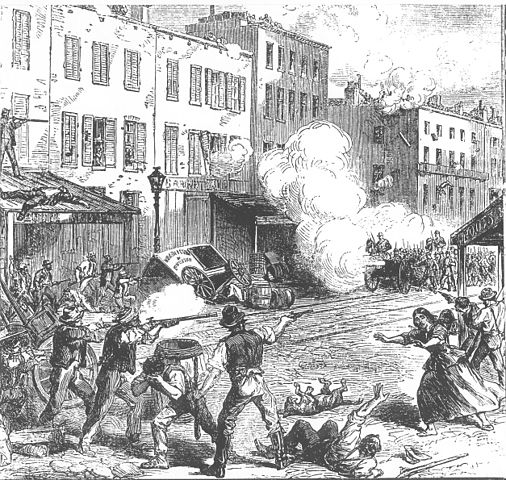
Incidents like this are much more common than civil wars. The worst civil disorder in US history was probably the New York Draft Riots of 1863. There were 34 people killed in the Watts Riots and 55 in the LA Riots of 1992, compared to an estimated 120 in the New York riots, out of a much smaller population. (Some estimates of the number killed range as high as 2,000, but those are not considered credible.) The pattern is familiar; the rioters raged out of control for days until outside force arrived to supplement the local police and restore order. (In this case, regiments of the Army of the Potomac, fresh from the Battle of Gettysburg.)
One incident in particular from the 1863 riots stands out to me.
Other targets included the office of the New York Times. The mob was turned back at the Times office by staff manning Gatling guns, including Times founder Henry Jarvis Raymond.
The New York Times had three Gatling guns, a weapon more advanced than anything the Federal Army had at the time, and used them to deter a mob (which went down the street and instead looted the Tribune, the staff of which was presumably less heavily armed than that of the Times).
We don’t have video of that one, obviously, but here’s a little sample of what the action was like. Note the cannon.
In 1921, The Tulsa Race Riot featured running firefights between white rioters and blacks trying to defend their neighborhood, while the usual looting and burning included air-dropped incendiaries. Somewhere between 30 and 300 people were killed.
Riots aren’t the only civil conflict we’ve seen in this country. The struggle for workers’ rights featured some pretty serious fighting between union workers and mercenaries hired by companies to break strikes. The Homestead Strike of 1892 featured a battle between thousands of striking union workers and hundreds of Pinkerton detectives. The strikers had not only small arms, but also a cannon. About 30 people were killed. The Battle of Blair Mountain in 1921 is the largest battle fought in the United States since the Civil War. It featured thousands of combatants, air strikes, a million rounds of ammunition fired, and 80–150 men killed.
A fairly comprehensive list runs to dozens of entries. Most of the disturbances are of a very small scale, but some, as outlined above, are quite substantial. We’ve been fortunate; there are civil disturbances in history that make the L.A. Riots look like a boisterous night at the local bar. The Nika Riots of 532 A.D. saw about 30,000 slaughtered in Constantinople and estimates of those killed in the St. Batholemew’s Day Massacre in 1572 range from 2,000–30,000. It can happen in any country, in any period of history. Even modern England and France are not immune.
Rioting of one sort of another and extreme workplace negotiations make up most of the incidents of civil disturbance we’ve seen in US history, but there is another kind of disorder that I’d like to look at: Political violence. I don’t mean revolution or other large-scale political violence, but smaller-scale action between the partisans of two or more political factions. It was a feature of the late Roman Republic as well as Weimar Germany, among others. An example of this sort of thing would be people from one party attacking a polling place, taking it over, and only allowing members of their own party to vote.
This is the one that worries me. We’ll have more riots in the future, but those tend to be almost random events, typically in response to local circumstances, and rarely lead to wider conflict. Low-level political violence can easily grow and spread. Looking at the last few Presidential elections, and the level of rhetoric and vitriol on both sides, I’m afraid that, if it continues to escalate as it has, we may be only a few electoral cycles from the beginning of this sort of violence. And before you say that it can’t happen here, be aware that it has. The Battle of Athens in 1946 was a firefight between county deputies and the “GI Non-Partisan League” over physical possession of the ballot boxes from a county election.
I hope that the rhetoric and high emotions get dialed back before shouting and name calling turn into beatings, assassinations, and street fighting. I really do. But these things do happen in many places, in many times, and I have to acknowledge at least the possibility that what has happened in the past might happen again in the future. I can’t ignore my own Law of History: “History doesn’t repeat itself. It just gives pop quizes to see if anyone was paying attention.”
I would love to know what plans our political leaders have for dealing with outbreaks of street-level political violence. I don’t think any want to encourage it, but they’re certainly aware of the possibility and doubtless have some kind of plan. They would be grossly irresponsible if they didn’t. It is, for example, probably not entirely coincidental that Democratic politicians, whose party members tend not to be as heavily armed as their opponents, support various gun control measures. That’s simply smart politics, and the sort of thing you have to be aware of if you’re going to play the game at a high level.
* * *
We also face the possibility of events outside of our control, such as global warming that may set populations on the move (it’s too late to stop it; the best we can do now is try to reduce it and hope for the best) and true wildcards like getting smacked with a big rock from outer space. A very rare, effectively random catastrophic event could completely change–or destroy–our civilization. It has happened before. All bets are off if we get hit with something like that; it would literally be a whole new world.
When people say that something ‘could never happen’ I smile, because ‘never’ is a very, very long time.
Wrapping It Up
I’ve tried to bring some perspective to this debate. Far too many people are shot to death in this country, certainly, but the demonization of gun owners as all being collectively responsible for every one of those deaths goes too far. More than four times as many children under 12 drown each year as are killed with guns, but we don’t demonize swimming pool owners. Gun violence has been declining for years, even though people will tell you exactly the opposite. To solve a problem you must understand what the problem is, and you probably should know if it’s even the biggest problem you face.
More than the actual deaths caused by people using them, ‘assault weapons’ are, I think, a proxy for our fears. They seem the very embodiment of ‘stranger danger’; the bad man who is going to come out of nowhere and hurt your children. But they are used in a very small number of crimes, and are just the sort of weapon that your children or grandchildren may desperately need someday, to counter a threat that isn’t even on your radar. I’ve tried to show a few examples of such situations that people have found themselves in in the past. Banning ‘assault weapons’ would be a feel-good act, a psychological salve for a few people, but would have no measurable impact on actual crime, and may very well cost lives in the future. How can I be so sure a ban wouldn’t reduce crime? We’ve done it before, remember. It didn’t make any difference then, and there’s no reason to think it would make any difference now. It’s basic math; banning something that is used in a tiny number of crimes is going to make, at best, a tiny difference in crime. It simply can’t do more, and may well do less.
Weapons like the AR–15 elicit strong emotions, just as certain kinds of speech do, and like potentially offensive speech it’s the potentially offensive weapons that need the protection of the Bill of Rights. They are what those Amendments are for. Mild and inoffensive speech doesn’t need protection any more than mild and inoffensive guns do. We can’t depend on the government to protect those rights for us; they’re aimed at limiting the power of the government, so naturally our leaders will find excuses to chip away at them. It’s up to us to protect our rights. All of them. Sell your neighbor’s rights today, and yours will probably be on the block tomorrow. Divide et impera; divide and rule.
Our children and grandchildren may have to struggle someday to take back the rights we give up today (not just gun rights, but all of them), cursing us every step of the way.
The challenge we face is preserving these weapons against future need, while limiting the harm that they can do in the wrong hands today. I believe that we are best served by focusing on the crazy people who want to commit atrocities, rather than focusing on the weapons that a few of them have used. There are a lot of things that can be turned into weapons if a person cares to do so; finding the crazy people is easier and more effective than trying to eliminate all the things that might be used to hurt us. We need to find out what drives these people, especially if we’re creating them.
Just as we can’t depend on our politicians to defend our rights, we can’t depend on them to stop, think clearly and rationally, and propose a solid solution aimed squarely at the actual problem. It’s up to us; we have to do the hard thinking and make them do the right thing.
Here’s a question for you. If a gun is bad for civilians to have, is it also bad for the police to have?
That’s not just a case of sour grapes, of, “Well, if I can’t have them, they can’t either, so there!” We have a real problem in this country with police shootings. In all of 2011, German police fired 85 shots in encounters with other people. (Some thousands more were fired in putting down dangerous or sick animals.) Of those 85 shots fired, 49 were warning shots.
Let me say that again. All of the police, in the entire country of Germany, in the year 2011 fired 36 shots at human beings. Of those, 21 shots hit their targets.
In the United States, a single policeman can easily exceed the lead output of all Germany’s cops in a single shooting.
There’s the case of a Garland, TX police officer who rammed his car into a suspect’s truck, got out, and fired 41 shots into the side of the truck, reloading at least twice in the process.
He seems to have at least hit the truck with most of the shots.
Los Angeles police unloaded 90 rounds on some guy who they say took a “shooting stance.” I haven’t been able to find how many of those shots actually hit their target (vs. how many were sprayed at large around the countryside), but I can guarantee you it wasn’t 90.
I could go on and on. Police in the US fire what seems like an excessive number of shots in so many encounters that they had to make up a term for it: Contagious Shooting Basically, when one person starts shooting, everyone wants to get in on the act.
In at least most of these shootings (and most police shootings in general), the cops are justified in using deadly force. I’m not saying that none of the people should have been shot, or that the police are always in the wrong. I want to be very clear about that. There are decent cops out there doing the best they can, and most of the time when the police shoot someone, well, I probably would have shot them too if I’d been in the cop’s position. I can’t fault someone for that.
And, of course, they almost always get away with it. Police departments conduct their own investigations, without public oversight, and it is very, very rare that they find that one of their own did something wrong, no matter how egregious the case may seem. The story above, about the Garland, TX cop who shot the unarmed motorist 41 times? (Well, shot at him 41 times; he obviously missed a lot, looking at the picture of the truck, but he hit the guy enough times to kill the hell out of him.) He’s on ‘restricted duty’ while the department ‘investigates.’ Four months later, there is no word about the outcome of their investigation, but he still seems to be collecting his $64,465/year paycheck
Here’s a prediction: If you were to walk up to someone who had irritated you in traffic, pull out a gun, empty the magazine into the side of their car, reload, empty that magazine, reload again, and fire several more bullets, killing the offending motorist, there is an excellent chance that you would be arrested. A police officer might be fired, but probably not.
What I’m getting at with all of this is that I think the police should be restricted to using the same weapons as the rest of us. The Saigon police at the height of the Vietnam war carried .38 caliber revolvers. There is no reason for police officers to be as heavily armed, or more, than a Marine in a firebase in Afghanistan. If, as so many people tell us, ‘assault weapons’ are weapons only good for killing as many people as possible in a short period of time, why do those same people want the police to have them?
With that in mind, I have sent my legislators the following legislation. All it does is restrict the police to using the same weapons that are legally available to the residents of their jurisdiction, and provides for (significant) penalties if they violate it. I’m serious about this. Read it, and if you think it’s a good idea, contact your Representative or Senators and tell them.
To ensure that law enforcement agencies represent the standards of the communities that they serve, no agency whose representatives, agents, employees, or contractors carry weapons shall use, issue, or carry any weapon category, type, brand, model, caliber, or capacity, or any ammunition, accessories, or attachments for such weapons, that are not legal or available for the common citizens of that jurisdiction. State and local law enforcement agencies must comply with the restrictions applicable to the residents of their state or municipality, Federal agencies must comply with the relevant Federal laws. Officers of a State agency operating in a municipality with stricter availability laws will still only be restricted by the relevant State laws. Likewise Federal officers operating in a State or municipality with stricter availability laws shall only be restricted by any relevant Federal, nationwide, restrictions.
This law shall apply to all government agencies excepting only the military branches (U.S. Army, Marine Corps, National Guard, Air Force, Navy, and Coast Guard).
Any resident of an agency’s jurisdiction may bring suit against an agency which is in violation of this law. Each proven violation shall result in a fine of $1000 per resident of that jurisdiction levied on the agency, payable directly to each resident.